Showing posts with label charles w.guildner. Show all posts

Saturday, February 9, 2019

Yo Will Smith! Your birthday tribute to my dad for saving your brother's life may be misplaced


As Sidebar readers know, in 1976 my friend, retired anesthesiologist Chuck Guildner MD of Everett, WA, published a research study that concluded chest thrusts are more effective for responding to a choking emergency than my dad's namesake below-the-ribcage abdominal thrust maneuver.

Since then, there's been a lively debate in the medical community over which is the most effective and safest treatment.

For example, last August fellow blogger Anthony Pearson MD of St. Louis (aka The Skeptical Cardiologist) published the provocatively-titled A Call To Reconsider The Heimlich Experiment: Let’s Scientifically Determine The Best Approach To Choking Victims.

Along those lines, an emergency medicine specialist once asked me, "How many successful choking rescues using chest thrusts have been incorrectly attributed to the Heimlich maneuver?"

Based on the above animated fun video posted on February 3, 2019, one such case may have been the brother of multi-talented actor/comedian/producer/rapper/songwriter Will Smith.

Here's Will's narration:
Today is Henry Heimlich's birthday. I actually saved my brother's life once with a Heimlich maneuver.

McDonald's had come out with that McRib sandwich and he went and got the McDonald's McRib. And we were pulled over in Philly and all of a sudden my brother just punches me in my back and I'm, like, "Ow man, shit!"

And I turn around and he's in the car and he's going (makes extreme gestures indicating choking) and he's doin' that.
So I reached down inside of the car and got right below the sternum...

[Ghostly apparition of my dad] "Use the Heimlich, Will!"

And it was barrelin' [?] the up move and the down and the McRib sandwich shot out of his nose onto the windshield, it was a full splash out of his nose.
Imitating his brother: "You saved my life, you saved my life!"

So happy birthday, Henry Heimlich, you actually saved my brother's life.
I have zero expertise in physiology, but I'm not sure how the McRib went from his brother's esophagus through his nose!

That aside, since Will was outside the car and reached in through the window, it's difficult to imagine his arms were long enough to get below his brother's rib cage.

And Will says he squeezed "right below the sternum." That sounds like a chest thrust.

Therefore, Will's birthday tribute to my pa appears to have been misplaced.

Shouldn't he be thanking Dr. Guildner?

Yo Will, if you and/or your brother want to check in with Chuck to express your gratitude for getting the better of that McRib, he's alive and well and regularly navigating the waterways near his home in Everett, Washington near Seattle.

Feel free to e-mail me for Dr. Guildner's contact info.

Charles W. Guildner MD

Friday, February 1, 2019

Audi Super Bowl TV commercial features "lifesaving choking rescue" using chest thrusts [UPDATED 3/1/19]

As Sidebar readers know, in the medical community there's been a 40-year debate whether chest thrusts are more effective and safer for responding to a choking emergency than my dad's namesake abdominal thrust maneuver.

The debate began with the publication of a 1976 a research study by my friend, retired anesthesiologist Chuck Guildner MD of Everett, WA, which concluded chest thrusts were an improvement over than "the Heimlich." (Click here for more about that.)

Car manufacturer Audi appears to agree with Chuck.

Via Audi's electrified Super Bowl ad by Larry P. Vellequette in today's Automotive News:
Spoiler alert: Audi's electrified commercial for Sunday's Super Bowl is a little nuts.

...Seated inside the electric sports car, the man presses the start button, bringing the car to life, but before he can drive off, his chest begins to convulse. The setting abruptly switches to a cubicle in an office, where the man, unconscious, is being given the Heimlich maneuver by a co-worker, and spits out a single cashew that had choked him. He regains consciousness, clearly disappointed.
In fact, the man is not given the Heimlich maneuver, he's clearly being given...oh, just watch it and see for yourself.


2/20/19 UPDATE: The Cornell Chronicle published a February 7, 2019 item which incorrectly identified the chest thrust anti-choking treatment performed in the Audi Super Bowl commercial as the "Heimlich maneuver." Click here an archived copy.


As a result of my outreach (which resulted in a fun exchange with Chronicle editors), yesterday the publication published this correction in an updated version of the item:


Other publications made the same error, so I'm sending them this item with requests for published corrections. I'll report the results here.

My original item is below the hash marks.

3/1/19 UPDATE: After receiving my corrections request re: his 2/1/19 item, TopSpeed.com reporter Jonathan Lopez took the


Tuesday, June 20, 2017

Choking first aid: Are New Zealand, Australia, and a guy in Rochester, NY, ahead of the curve?

As Sidebar readers know, medical authorities in New Zealand and Australia don't recommend the Heimlich maneuver (aka abdominal thrusts) for responding to a choking emergency.

Per Aviva Ziegler's 2009 documentary, in the Land Down Under my dad's namesake treatment is considered unproven and potentially harmful.

That opinion was echoed in the American Heart Association's 2005 guidelines which state, "Life-threatening complications have been associated with the use of abdominal thrusts."

Instead Kiwi and Oz first aid experts recommend back blows and chest thrusts.

The latter treatment was first proposed in a 1976 study by my friend Dr. Chuck Guildner of Everett, Washington. Click here for more about that and related information.

Yesterday, Radio Live New Zealand aired Do you know what to do when a child is choking? which included this clip of first aid instructor Billy Doyle explaining the back blows followed by chest thrusts protocol. To my knowledge it's the first time the chest thrusts treatment has been described in a video.


As it happens, "the Heimlich" has been credited with saving choking victims when, in fact, the rescuer performed -- yep -- back blows and chest thrusts.

For example, in January a dashcam video of a dramatic choking rescue in Rochester, NY, was picked up by numerous news outlets.

Via the original YouTube video, here's the description:

source

Here's the video:


Tuesday, January 14, 2014

UK pooch challenges U.S. Surgeon General's choking rescue recommendations!

source

Via the June 18, 2013 Houston Chronicle
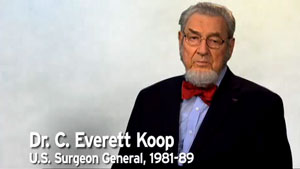
There has been an ongoing debate about the Heimlich maneuver and whether or not it is the most effective method. In 1985, Surgeon General C. Everett Koop said, “Millions of Americans have been taught to treat persons who are choking with back blows, chest thrusts and abdominal thrusts. Now, they must be advised…and I ask for the participation of the Red Cross, the American Heart Association and public health authorities everywhere…that these methods are hazardous, even lethal.”
The American Heart Association and American Red Cross criticized Dr. Koop, but later followed suggested guidelines by only teaching the Heimlich. In 2005, the AHA and ARC changed their position by stating that “back blows, abdominal thrusts and chest compressions are equally effective” treatments for responding to a choking emergency.
Via a February 21, 2007 Creators Syndicate column by Lenore Skenazy: 
What most people don't realize, Dr. Heimlich's son, Peter Heimlich, said, is that "Koop was an old friend of my father's, and he did it as a buddy favor."

Lesley Hailwood and Nell (source)

Now a four-legged medical researcher named Nell (pictured above) has entered the debate to further challenge the late Dr. Koop's findings.

Via a report yesterday in the Liverpool Echo, here's how Lesley Hailwood described what happened after she started choking on a piece of chocolate:


After reading about this possible medical landmark, I contacted my friend, Charles W. Guildner MD of Everett, Washington.


Charles W. Guildner MD, July 2011; click here for contact his info

As Sidebar readers know, Dr. Guildner conducted a research study published in the September 1976 Journal of the American College of Emergency Physicians (JACEP).

His results?

Chest thrusts were more effective than abdominal thrusts ("the Heimlich").

Per a 2007 Seattle Public Radio report, my father than tried to ruin him.
GUILDNER: "It's so repugnant to me the way Dr. Heimlich has bullied...He's a bully and he has bullied people into submission."
DR. HEIMLICH IS IN HIS 80'S AND LIVES IN OHIO. HE DID NOT RETURN CALLS FOR THIS STORY.
Long retired from medicine, Dr. Guildner is now a prominent fine-art photographer and teaches photography at the college level.

He's also a wry observer of the human condition, so who better to ask for a reaction comment about Nell's dramatic chest thrust rescue?

After I sent him the Liverpool article, here's what came back:
Yes, amazing isn't it? I have been training dogs to do this for many years. While in training the dogs act as though, yes, isn't it obvious that applying chest pressure is the logical thing to do?

Sometimes, dogs are a lot smarter than some people!
Sometimes even smarter than a Surgeon General.

Wednesday, February 22, 2012

Six years after the American Heart Association recommends chest thrusts for choking rescue, the story gets reported...sort of


From Life Saving Skills: A New Way to do the Heimlich Maneuver by Maddie Garrett, KATC-TV News, Lafayette, Louisiana, February 8, 2011:
(The) rules on what to do if someone is choking have changed, and there's a new way to do the Heimlich Maneuver...(If) the person choking becomes unconscious, the rules have changed. Instead of pushing up in the abdomen, (Registered Nurse Ella Beth) Goetschius said it's better to perform more like CPR, minus the breaths of air. She said to lay the person on the floor, do 30 chest compressions, then open the mouth and check to for the object.
First, contrary to the report, this information ain't new.

From the 2005 Adult Basic Life Support guidelines published in Circulation, the journal of the American Heart Association (AHA):
Treatment Recommendation
Chest thrusts, back blows/slaps, or abdominal thrusts are effective for relieving FBAO (Foreign Body Airway Obstruction) in conscious adults and children >1 year of age, although injuries have been reported with the abdominal thrust. There is insufficient evidence to determine which should be used first. These techniques should be applied in rapid sequence until the obstruction is relieved; more than one technique may be needed. Unconscious victims should receive CPR. The finger sweep should be used in the unconscious patient with an obstructed airway only if solid material is visible in the airway. There is insufficient evidence for a treatment recommendation for an obese or pregnant patient with FBAO.
Five years later in 2010, the most recent AHA guidelines were near-identical:
Although chest thrusts, back slaps, and abdominal thrusts are feasible and effective for relieving severe FBAO in conscious (responsive) adults and children ≥1 year of age, for simplicity in training it is recommended that abdominal thrusts be applied in rapid sequence until the obstruction is relieved.  If abdominal thrusts are not effective, the rescuer may consider chest thrusts. It is important to note that abdominal thrusts are not recommended for infants <1 year of age because thrusts may cause injuries. 
Second, the guidelines say chest thrusts are recommended as effective for conscious choking victims. For some reason, the TV story only reported that the treatment should be done on unconscious victims.

Confused? Yeah, me too.

But there's one thing I'm reasonably sure of.

Over six years after the AHA began recommending chest trusts as an alternative choking rescue treatment, to my knowledge this is the first TV news story to report the information. 

On the bright side, in Cajun country, KATC viewers have been informed about this potentially lifesaving skill.

At this rate, it's only a matter of decades before the rest of the country gets the news!

Charles W. Guildner MD, July 2011; click here for contact info

Incidentally, the idea that chest thrusts could be effective for choking rescue was introduced in a 1976 published study by Charles W. Guildner MD of Everett, Washington.

Per this 2007 Seattle Public Radio report by Patricia Murphy, Dr. Guildner explained how my father tried to derail his work:
By the time the chest thrust study was published in 1976, Dr. Heimlich had filed complaints against Dr. Guildner with 6 different medical groups. Eventually Guildner was cleared of all charges, but by then the Heimlich maneuver had become firmly entrenched as the primary method for choking response in the US....

GUILDNER: "It's so repugnant to me the way Dr. Heimlich has bullied. He's a bully and he has bullied people into submission."

In his quest for what reporter Thomas Francis called the "choking rescue crown," my father also called in some medical muscle in the form of US Surgeon General C. Everett Koop who used his federal government pulpit to stomp the competition and put the debate on ice.

From Koop's Declaration regarding the Heimlich Maneuver, Public Health Report, US Department of Health and Human Services, September 30, 1985:
(Dr. Koop) urged the American Red Cross and the American Heart Association to teach only the Heimlich Manuever (sic) in their first aid classes. Dr. Koop urged both organizations to withdraw from circulation manuals, posters and other materials that recommend treating choking victims with back slaps and blows to the chest...these methods are hazardous, even lethal."
The result? From a 2007 Creators Syndicate column by Lenore Skenazy:
After that, only the Heimlich Maneuver was considered kosher.
The fix?
What most people don't realize, Dr. Heimlich's son, Peter Heimlich, said, is that "Koop was an old friend of my father's, and he did it as a buddy favor."