Today, our nation celebrates National Heimlich Maneuver Day - along with National Nail Polish Day, National Olive Day, and National Say Something Nice Day.
Therefore, in the spirit of National Say Something Nice Day, I have something nice to say about this vile enterprise.
It's on life support.
From Letter from Henry J. Heimlich, M.D., published in the Winter 1998 issue of the Heimlich Institute's "Caring World" newsletter, here's some history (emphasis added):
The mission of The Heimlich Institute is "Benefiting Humanity Through Health and Peace." When Deaconess Associations Inc. invited the Institute to become affiliated and to move into the Deaconess Hospital complex, it brought together two organizations with the same goal – saving lives. Most meaningful for me is that the creativity of The Heimlich Institute research will now continue in perpetuity. Some say it will be for Cincinnati what the Pasteur Institute is for Paris.
From the same newsletter:
The work of one of the century’s most influential physicians will continue through a new partnership. In June, The Heimlich Institute became a member of Deaconess Associations Inc. Deaconess will assume responsibility for advancing and promoting the mission and vision of The Heimlich Institute in perpetuity.
Four years later, my wife Karen Shulman and I, along other determined critics, started chipping away at the dangerous scams being run out of the Heimlich Institute (HI), an effort that resulted in scores of mainstream print and broadcast reports.
Per this first-rate ABC7 Chicago expose by Chicago investigative reporter Chuck Goudie - in which "one of the century’s most influential physicians" hid behind my mother - by 2005 the HI was a shell; an empty office with no employees.
Since then, it's been an "in name only" organization: no assets, no income, no nothing - except filing near-blank annual IRS filings like this most recent 990-PF dated March 21, 2024.
In other words, "perpetuity" lasted less than seven years.
Here are the two remaining principals, my brother Phil Heimlich (a former high-profile elected official), and E. Anthony "Tony" Woods, the Cincinnati tycoon responsible for making the HI part of Deaconess Associations Inc. about 25 years ago.
Here's a good question.
Decades after the Heimlich Institute collapsed, why are they keeping this defunct organization alive, if only on paper?
Phil Heimlich was the politician he's come to despise.
"I regret not showing more courage," he told Politics Extra.
It's a harsh reality Heimlich has come to grips with since he left public office 10 years ago this month.
...Heimlich, 64, has never come back to politics since that bruising and brutally expensive 2006 loss to Democrat David Pepper in the commissioner's race. Heimlich has no plans to come back, but the Republican still loves to talk politics.
Phil:Just to fully give you my kind of priorities. I'm also what you'd call
an Evangelical. I'm a Christ follower. But...and I got something to say
to my fellow Evangelicals.And I'll quote the words of a commentator, a
liberal commentator. But I'll quote him but it's true. What he said was,
and I agree, "Our support for Donald Trump exposes us as the shameless
hypocrites we've always been."
11/16/18 UPDATE: Hat tip to an attentive reader who informed me that in 2009 Maher was the recipient of the Atheist Alliance of America's Richard Dawkins Award.
That's one reason it bugs me when journalists refuse to publish corrections for straightforward factual errors.
And that's one reason why the other day I filed a misconduct complaint against Margaret Holt, Standards Editor at the Chicago Tribune and a prominent figure in the newspaper business.
They're on the warpath because the ARC recommends performing back blows along with our dad's namesake maneuver (abdominal thrusts) to respond to a choking emergency.
In my opinion, Ms. Olumhense's story has some serious reportorial problems. (Re: the medical issues, visit my web page for links to related published documents.)
(Leading) U.S. medical and first-aid groups, including the American Heart Association, the American College of Emergency Physicians and the National Safety Council all advise people to use Heimlich-style abdominal thrusts only...
What's the problem?
It's this word: only.
I wasn't sure about the National Safety Council (NSC), and the American College of Emergency Physicians (ACEP), but I knew that in addition to our dad's famous treatment, current American Heart Association (AHA) guidelines recommend back blows and chest thrusts for responding to choking emergencies.
So the day her article appeared, I e-mailed a friendly note to Ms. Olumhense, explained that I had questions, and politely asked her to provide her editor's name and e-mail address so I could copy her/him on my correspondence. A short time later I received this:
Mr. Heimlich:
Your email was referred to me for response. The story is straightforward in quoting people about the topic, including a reference to a disagreement between some family members and the Red Cross. There is nothing further beyond what is in the published article.
Sincerely,
Margaret Holt
Standards Editor
Since I knew the part of the sentence about the AHA was wrong, I realized Ms. Holt didn't know what she was talking about.
And since she didn't ask what my concerns might be, presumably she didn't care, so I same-day replied:
Margaret,
Would you please provide me with your superior's name and e-mail address?
Thank you for your continued attention and I look forward to your reply.
Cheers, Peter
A week later I hadn't received a reply, so on July 23 I sent a friendly "can you help me?" e- mail to Tribune Managing Editor Peter Kendall who some years ago had capably assisted me with an unrelated editorial problem.
He passed the baton back to Ms. Holt:
Mr. Heimlich,
Thank you for your email.
I am copying Margaret on this so you can share any specific questions or concerns about the story.
She is the appropriate person to handle this.
After thanking him, I e-mailed media representatives at the AHA, NSC, and ACEP and asked for their organizations' positions.
An AHA Vice President e-mailed me this, taken from the organization's current guidelines (my emphasis):
“…chest thrusts, back slaps, and abdominal thrusts are feasible and effective for relieving severe FBAO [Foreign Body Airway Obstruction] in conscious (responsive) adults and children over 1 year of age.
The NSC rep replied that their organization adheres to AHA guidelines.
And an ACEP manager in that organization's communications department e-mailed me that their organization "does not have a formal policy on the Heimlich maneuver."
Based on those e-mails, the Tribune's claim that the three organizations "all advise people to use Heimlich-style abdominal thrusts only" is unequivocally wrong, ain't it?
Along the way I also identified what may be the source of Ms. Olumhense's error.
The American Heart Association teaches the Heimlich Maneuver as the only method to be used to save a choking victim, as does the National Safety Council and the American College of Emergency Physicians.
In any event, after obtaining the information from the AHA, NSC, and ACEP, I was on firm ground, so on August 7 I e-mailed the facts to Ms. Holt and requested a published clarification.
A week later I hadn't received a reply from Ms. Holt, so -- you guessed it -- on August 15, I asked Peter Kendall to step in. A short time later I received this...
Mr. Heimlich: We have reviewed your correspondence and disagree with your conclusion about factual errors. There is no correction planned. Sincerely, Margaret Holt
...to which I replied:
The information I provided to you from the AHA, the NSC, and ACEP clearly contradicts the sentence in Ms. Olumhense's article, therefore please clearly state the basis for your disagreement. If you intend to provide me with an adequate, professional response, please do so before this weekend so I may know how to proceed.
Over a week later, no reply (click here for the entire e-mail trail of tears) and I could think of only one other available avenue of possible recourse.
So a couple days ago, I phoned the Tribune's switchboard and explained that I wanted to file a misconduct complaint against a newsroom employee.
I was transferred to a representative of a company that handles complaints for the Tribune, NAVEX Global Inc., based in Lake Oswego, Oregon, a Portland suburb. The NAVEX rep was a helpful, articulate fellow who informed me that they didn't accept written complaints. That struck me as odd and I wanted a record of the transaction, so I recorded the call.
I explained the situation and he patiently and courteously took notes.
Next he put me on a brief hold to arrange his notes into a formal complaint, then came back on the line and read it to me for my approval.
I suggested a few tweaks which he incorporated in this final version:
I'll report any developments in a future item but even if my complaint falls on deaf ears, the excursion was worth my time because Ms. Holt's incompetent, unprofessional handling of such a small problem may signal deeper rot. That is, if Ms. Holt buries easy-to-fix factual errors like this, how does she handle serious editorial problems?
With that in mind, if you've had any related experiences with her, drop me a line.
From: Peter Heimlich <peter.heimlich@gmail.com>
Subject: Re: Questions for an item I'm blogging
To: Phil Heimlich <philheimlich1@gmail.com>
Cc: Justin Wise, Charles W. Guildner MD, [Enquirer opinion editor] Kevin Aldridge, Robert Anglen, Gregory Korte, [Enquirer politics reporter] Jason Williams, [Hamilton County, Ohio, Commissioner] Todd Portune
Date: Tue, 19 Jun 2018 13:20:09 -0400
Phil,
I didn't receive your reply to my June 15 e-mail re: whether or not you're still doing the Hard Truths With Phil Heimlich podcast. Would you please get back to me on that?
1) Based on the commitment to democratic values you expressed in your column, do you have any comments re: any of the information in these Enquirer articles from when you held elected office?
“It means more of the same and it makes me nervous,” says Jenny Laster, president of the Grass Roots Leadership Academy, which trains community leaders and which recently fell into Mr. Heimlich's sights. “If he becomes a commissioner, I'll be the first person he wants to run out of town on a rail.”
She says Mr. Heimlich is divisive and destructive, and cites his inquiries about the academy as an example. He started by questioning how much the city was paying the academy to train community leaders and then tersely derided the program as being more expensive than Harvard.
“I haven't seen him accomplish anything, other than to further polarize this community,” Ms. Laster says. “There's a way to get information without stripping dignity from people.”
And she says he operates with impunity against minority organizations.
“If that sounds like I'm calling him a racist, well, if the shoe fits, then I'm sorry,” Ms. Laster says.
...Last year, four black civic and business leaders wanted Mr. Heimlich gagged and called for city officials to investigate him.
Representatives of the Urban League, the African American Chamber of Commerce, Genesis Redevelopment and the Riverfront Classic and Jamboree claimed that Mr. Heimlich had used his office as a tool of intimidation by persistently seeking information about groups that serve the black community.
He demanded financial statements, questioned salaries, probed expenses. Black leaders claimed that he unfairly targeted their organizations. While City Council refused to investigate Mr. Heimlich, some members questioned his methods and his manner as rude and unproductive.
“It has been a real problem,” Urban League President Sheila Adams says of Mr. Heimlich. “But I am not going to use his tactics.
Conservative activists fighting a gay rights ballot measure in Cincinnati bought more than $500,000 worth of television ads on Sept. 30, local stations say.
...The Focus on the Family Cincinnati Committee has bought several full-page ads in Cincinnati newspapers featuring Hamilton County Commissioner Phil Heimlich.
...In the ad, Heimlich rebuts claims from repeal supporters that Article XII has cost the city millions in lost convention business.
Heimlich conducted the study while he was a paid consultant to the Citizens for Community Values. CCV paid Heimlich $55,000 in 2002, according to the group's tax return and Heimlich's state ethics disclosure form.
Incoming Hamilton County Commissioner Phil Heimlich has been employed by CCV as a paid consultant for the past year since leaving his Cincinnati City Council seat.
...He says he developed a close relationship with CCV as a city councilman, after Mr. Burress suggested that Cincinnati needed zoning measures to keep sexually-oriented businesses out of the central business district. Mr. Heimlich then successfully spearheaded legislation to do just that in 1996.
3) Based on the commitment to a free press which you expressed in your column, per my previous e-mail, a source informed me that you helped kill a KING5 News (Seattle) report about a 1976 research study about foreign body airway obstruction by Dr. Charles W. Guildner by threatening executives at the station with legal action. Is that true? If so, why did you do it?
4) Does (your wife and my sister-in-law Rebecca Simpson Heimlich, a longtime Koch brothers employee) plan to join you in voting for Democrats in national races in the upcoming mid-terms? Also, re: the photo of Rebecca and Corey Lewandowski (above), was that taken at the 2016 National Republican Convention? If not, what's the source?
5) Who's your supervising editor at the Enquirer?
Thanks for your continued time/attention and if you intend to respond, would you please get back to me by end of the day tomorrow?
Your brother, Peter
Peter M. Heimlich
Peachtree Corners, GA 30096
ph: (208)474-7283
website: http://medfraud.info
blog: http://the-sidebar.com
e-mail: peter.heimlich@gmail.com
Twitter: @medfraud_pmh
I haven't received a reply. Also I left a voice message and sent a couple of e-mails to Kevin Aldridge, the Enquirer's opinion editor, asking for the name of Phil's supervising editor. I haven't received a reply -- PMH
Ironically, as a result of me posing that question to Deaconess Associations (the Cincinnati corporation that wholly owns the Institute), they re-upped with the state.
Here's the August 3 response I got from Jackie Wiesman, assistant to Deaconess chairman Anthony Woods, a Queen City tycoon who who arranged the acquisition of the Institute in 1998:
Peter: Our office address changed and the recertification request that was sent this past month was not forwarded to the new address. It is being reinstated as we speak. Jackie
Per my previous item, the recertification notice from the state was dated March 22, not this past month -- so Ms. Wiesman got that wrong.
On the other hand, the Institute -- a 501(c)(3) nonprofit -- hasn't had any employees since 2005 when it became nothing but a website.
And as of 2015 the organization had zero assets, so presumably no one's minding the store.
In flusher years, the Institute was the focus of investigations by the CDC, FDA, and the Justice Department for overseeing and funding notorious offshore experiments in which US and foreign patients suffering from Lyme Disease and AIDS were infected with malaria.
Despite considerable related reporting (much of it based on research by my wife Karen and me), to my knowledge, neither Woods nor Phil have ever been asked by reporters about their knowledge and roles in the abusive experiments which bioethics experts have called medical "atrocities."
Moving right along, I sent Ms. Wiesman at Deaconess these follow up questions:
1) Are you able to provide me with the current assets of the Heimlich Institute (HI)? Per my blog item, the most recent IRS 990 (2015) shows bupkis.
2) Who are the current members of the HI board?
3) My understanding is that the HI has no employees. Is that accurate? If so, in what year did the organization last have employees?
4) My understanding is that the HI is currently an IRS-approved 501(c)(3) nonprofit. Is that accurate?
Her reply:
Peter: Not at liberty to disclose this information.
Here's another question.
Now that it's a shell of an organization, should the Heimlich Institute still be entitled to 501(c)(3) nonprofit status?
The mission of The Heimlich Institute is "Benefiting Humanity Through Health and Peace." When Deaconess Associations Inc. invited the Institute to become affiliated and to move into the Deaconess Hospital complex, it brought together two organizations with the same goal – saving lives. Most meaningful for me is that the creativity of The Heimlich Institute research will now continue in perpetuity. Some say it will be for Cincinnati what the Pasteur Institute is for Paris.
If this letter dated yesterday (with a misspelling of my last name in the address) is any indication, "perpetuity" lasted about 19 years:
Per this 2006 ABC Chicago expose by investigative reporter Chuck Goudie, for over a decade the Institute has been a shell organization without any employees:
Per this screenshot from the Secretary of State's website, this isn't the first time the organization's corporate status has been cancelled and revived, so perhaps it's premature to cast the final shovelful of grave dirt:
From the same filing, here are the most recent officers of the corporation. As widely reported, my dad died in December, but I'll follow up with my brother Phil and perhaps the others and will report the results.
A few months ago, the Cincinnati Enquirer's Politics Extra column ran an item by reporter Jason Williams about the latest media venture by my older brother Phil, Heimlich maneuvers to 'radical middle':
Heimlich, 64, has never come back to politics since that bruising and brutally expensive 2006 loss to Democrat David Pepper in the commissioner's race. Heimlich has no plans to come back, but the Republican still loves to talk politics. Last fall, he resurrected his "Hard Truths" podcast on iTunes and philheimlich.com. It's where you can get your fill of Phil.
...Politics Extra isn't sure anyone's listening yet, but Heimlich is hoping to gain a national following.
Based on articles in the New York Times and New York Daily News, both dated August 29, 1941, Phil (and his engineer/announcer Rob Reider) give big ups to our dad for having saved the life of a man in a dramatic high-profile train wreck the previous day.
At
age 21, after spending the summer working as a counselor at a summer
camp in Lenox, Massachusetts, he and hundreds of campers were heading
home when the train derailed in South Kent, Connecticut. Cars overturned
into the adjacent Hatch Pond, leaving two train workers dead and one
pinned down in four feet of water, his leg trapped under a car. Dad told
the reporters he held the man's head above the water until help
arrived. (To the best of my knowledge, he was interviewed at the train
terminal in New York City, presumably Grand Central.)
Phil also mentions this September 25, 1941 item in the Times. (Note the lab coat. Nice touch by our pa, media-savvy even then.)
What makes this interesting -- and a little spooky -- is that the same day the podcast aired, the newsletter of Connecticut's Kent Historical Society (KHS) published Who Saved Otto Klug? Investigating a 75-year-old mystery, my article about the train wreck.
My dad was no slouch when it came to singing his own praises to anyone in earshot and I was no exception. Most of our time together consisted of him telling me about his achievements and awards, especially after he became famous.
And that was my first problem with the train wreck story – over the decades he never mentioned it to me. I only learned about it in the early months of our research when (my wife Karen Shulman) and I happened upon the 1941 New York Times articles.
My interest was piqued, so about 14 years ago, I decided to take a closer look.
Via public libraries in Connecticut, I obtained copies of every article I could find about the headline-making disaster. I also contacted Marge Smith at the Kent Historical Society who sent me some paperwork from their files and put me in touch with Emily Krizan, whose husband, Joseph Krizan Jr., reportedly participated in rescue efforts at the train wreck, including helping the trapped fireman, whose name was Otto Klug.
Interestingly, none of the articles and none of the people with whom I communicated said anything about any camp counselor (or my father by name) being involved in the rescue.
Instead, they near-unanimously identified a local resident named Jack Bartovic as the person responsible for holding Klug’s head above water for hours.
Presumably Phil was unaware of these facts so last week I e-mailed him my article and these questions:
1) I'd be curious to know your thoughts about the contradictory claims I reported and in the articles posted on this web page I made: http://medfraud.info/OttoKlug.html Please feel free to elaborate.
2) Per my article, Henry never told Karen or me about the train wreck and no one else in the family (including you) ever mentioned it. We only learned about it in the early months of our research into Henry's career when we happened upon the two 1941 New York Times articles. Approximately when did you first become aware of the train wreck story and how did you hear about it?
3) In your podcast you read from the August 29, 1941 New York Daily News article about the wreck. I'd seen that article pasted-up in Henry's 2014 memoir [see below] but the text is too small to read. I haven't yet been able to obtain a copy of the article, so I was pleased to learn you've got one. Would you please send me a copy so I can check it out and add it to my web page?
I got a confirmation of receipt but no further communications.
I was especially interested in his answer to my second question.
That is, when did Phil first become aware of the train wreck story? Did dad keep him in the dark, too?
Here's a video clip of Phil relating the train wreck story while introducing dad at a January 27, 2015 event hosted by the Cincinnati Business Courier. (He was receiving the newspaper's Health Care Hero award, an honor reportedly arranged by his longtime attorney, Joe Dehner).
The way Phil tells it, it sounds like the first time he heard about the train wreck may have been eight months earlier when he came across the New York Times in the course of helping our parents move.
So I e-mailed the video clip from the awards event to Phil and asked if that was accurate.
Again I received his confirmation of receipt, but no further communications.
Apparently I'm on my brother's do-not-respond list, so if anyone asks Mr. Hard Truths about this, I'm curious to know how he responds. Click here for my contact info.
Via my father's 2014 memoir, Heimlich's Maneuvers.
A recent Cincinnati Enquirer story
went global, aided and abetted by the Associated Press. It was perfect click bait. The story said that at 96, Cincinnatian Henry Heimlich used
his Maneuver for the first time to save a life (of a purported choking victim, 87-year-old Patty Ris, at the Deupree House senior residence*).
...After
Peter Heimlich alerted The Enquirer and others to a similar claim (his father had made) years ago, the paper backed away from the novelty. It assigned a second reporter to redo the story, adding and explaining doubts about the “first” in the longest crawl-back I can remember.
Peter Heimlich told me that in addition to The Enquirer and AP, “these are some of the news outlets I filed corrections requests with last week: CNN, NBC News, The New York Daily News, and WCPO-TV. At this writing, none have corrected the errors.”
This is the second part of a series about my corrections requests regarding the lie my father told reporters. Those reports triggered the N.Y. State resolution -- and the original version included his lie -- hence this item.
* Reporters at McKnight's and Slate have questioned the veracity of the Deupree House story. So have I.
I do my best to prevent well-intentioned people from stepping in it, so when I happened across this June 16, 2016 New York State resolution with some factual errors and a problematic claim (my yellow-highlighting), I contacted the office of the official who introduced it, Buffalo-area Democratic Assemblyman Robin Schimminger.
A member of the assemblyman's staff promptly welcomed my outreach, informed me that the final version had not yet been filed, and cordially invited me to suggest any corrections.
I accepted the offer and the final version of the resolution, filed on July 1, 2016, incorporated my suggestions which I've blue-highlighted in the copy below.
Re: the first highlighted paragraph, to my knowledge, leading first aid organizations in most countries recommend first performing back blows when responding to a choking emergency; if that fails to remove the obstruction, rescuers should proceed with "the Heimlich" (abdominal thrusts).
Re: the second highlighted paragraph, click here for supporting documents.
In what I consider to be a sensible move, the revised version deleted the problematic claim that my father allegedly rescued a choking victim in 2001 at a Cincinnati's restaurant. (More about that mess via the Cincinnati Enquirer and the New York Times.)
I've done my share of copy editing, but this was a first for me, so I'm grateful to Assemblyman Schimminger and his staff for inviting me to participate.
If any other officials are considering issuing tributes to my father, please feel free to get in touch.
Two new easy-to-use devices work like plungers to suck out obstructions in the airway, providing another option if standard treatment—such as abdominal thrusts developed in 1974 by Henry Heimlich—fail to clear the airway, say the companies who sell them.
...Both the Dechoker, $89.95, and the LifeVac, $69.95, have a plastic mask that provides a seal over the mouth and nose while suction is provided. The Dechoker looks like a large syringe, while the LifeVac’s plunger is shaped like a small accordion.[Page down for graphics.]
...Skeptics include Dr. Heimlich, now 96. Such a device may not be handy in the “unexpected instance that a person chokes,” Dr. Heimlich, a retired thoracic surgeon from Cincinnati, says in a statement released by his son, Phil Heimlich. “Any action that delays use of the Heimlich maneuver or complicates the rescue can be deadly.”
Any action that delays "the Heimlich"?
Does that include backblows, chest thrusts and finger sweeps?
In any event, in recent months I've enjoyed some friendly correspondence with LifeVac inventor Arthur Lih and Christopher Kellogg, Dechoker's Chief Operating Officer, so I e-mailed them invitations to respond to my father's statement.
Mr. Lih declined. I haven't received a reply from Mr. Kellogg.
By the way, I'm pleased to learn that my father has apparently recovered from an unspecified "medical problem" which, according to my brother, recently prevented him from answering questions from a Cincinnati reporter.
The performance happened about two weeks after -- according to CNN reporter David Shortell -- my father "sprang into action" in the dining room of a Cincinnati assisted living community to perform his namesake maneuver on an 87-year-old woman sitting next to him.
A recent Cincinnati Enquirer story
went global, aided and abetted by the Associated Press. It was perfect
click bait. The story said that at 96, Cincinnatian Henry Heimlich used
his Maneuver for the first time to save a life (of a purported choking victim, 87-year-old Patty Ris, at the Deupree House senior residence*).
...After Peter Heimlich alerted The Enquirer and others to a similar claim (his father had made) years ago, the paper backed away from the novelty. It assigned a second reporter to redo the story, adding and explaining doubts about the “first” in the longest crawl-back I can remember.
Peter Heimlich told me that in addition to The Enquirer and AP, “these are some of the news outlets I filed corrections requests with last week: CNN, NBC News, The New York Daily News, and WCPO-TV. At this writing, none have corrected the errors.”
* Reporters at McKnight's and Slate have questioned the veracity of the Deupree House story. So have I.
#####
Since Spring 2003, my father has been thoroughly exposed as a medical charlatan, a serial liar, and a con man in scores of media reports, two of the first being these Sunday front-pagers in the Cincinnati Enquirer (based on research by my wife Karen and me).
It's tough to prove someone intentionally lied and Rosemeyer's story included some verbal acrobatics perhaps intended to step around that dead elephant in the room:
Maybe Henry Heimlich simply misremembered. Or maybe news reports from the early 2000s simply weren't true.
Either way, there's an irresolvable conflict: When did Dr. Heimlich first perform his namesake maneuver?
A month ago, just a few days before National Heimlich Maneuver Day, the Cincinnati doctor said he'd finally used it for the first time. He's 96 years old, and he invented the move to help choking victims more than 40 years ago.
Pretty incredible that he hadn't used it before then, right?
Except Heimlich apparently told the BBC in 2003 he'd performed it three years earlier, in 2000.
...Several other media outlets also covered that earlier story.
...The doctor's son, Phil Heimlich, said he, his sister and father have no recollection of the incident 16 years ago.
"It would have been a major news story, so we would have remembered," he said.
Presumably the "irresolvable conflict" could be resolved by asking my father, but the story didn't include any quotes from Dr. Maneuver or any indication that he'd been contacted, so I asked Rosemeyer about that.
He replied, "Phil said Henry had some health problems since last month, so he was calling me back instead."
Is this the first time Dr. Heimlich has ever used the maneuver to save a life?
“Yes, this is,” he said Friday. “I originally did my research studies that led to my developing it, which was in 1974, and I never considered that I would be doing it myself.”
The record is murky in that regard. A BBC article in 2003 quoted the doctor, then 83, describing a similar encounter where he tried the maneuver on a fellow diner, a man, although the story lacked details such as a precise date, location and name. A New Yorker article in 2006 made reference to a similar incident, also without details. But a son, Phil Heimlich, said his father had never mentioned any previous incidents to him. The doctor himself did not return a follow-up call.
Finally, if my father's ill, I wish him a speedy recovery.
And when he's better, I'd encourage reporters to interview him to perhaps resolve the "irresolvable conflict."
And if any reporters need someone on the record calling him a liar, I'm available.
The Physicians Committee for Responsible Medicine's The Henry J. Heimlich Award for Innovative Medicine
When the history books are written, I predict that my father will finally be awarded the recognition he deserves as a spectacular medical con man and master media manipulator.
As I told the LA Weekly, "My father is such a brilliant promoter, he could teach P.T. Barnum a few tricks."
But last week the master may have gone too far.
On Thursday evening, this headline was attached to a Cincinnati Enquirer article by staff reporter Kevin Grasha:
Less than 24 hours later, the headline and the article were substantially rewritten.
Via the body of the article, here's why (emphasis added):
When he heard that a resident was choking, Perry Gaines, maître d’ for the Deupree House dining room, ran toward the table.
...When Gaines arrived at the table, Dr. Henry Heimlich, a 96-year-old resident of the Deupree House who invented the famous technique for clearing a blocked airway, was standing behind the woman, ready to perform it.
Typically, a staff member would do it. “But,” Gaines said, pausing, “it is Dr. Heimlich.”
Heimlich, who swims and exercises regularly, was able to dislodge a piece of hamburger that had become stuck in 87-year-old Patty Ris’s airway.
...Monday’s incident at the Deupree House was the first time Heimlich...used it to stop someone from choking, he said.
The first time?
Not according to what my father told these four reporters in articles from 2001 through 2006.
TO THE RESCUE
The story sounds like it could be an urban legend, but it actually happened in the dining room of the Bankers Club in Cincinnati. During a busy lunchtime, a guest of the club began choking as he sat eating at a table. A member sitting at another table promptly rushed to the aid of the victim, wrapped his arms around the man’s waist, and pressed his fist upward into his abdomen, expelling the trapped object from the clogged airway. The quick-thinking member was none other than Dr. Henry Heimlich, who surprisingly had never before performed his namesake Heimlich maneuver in an emergency situation. But the good doctor says performing the maneuver in this scenario was “as easy as that. I’ve practiced enough, I guess, in my life"...At 81 years old, Dr. Heimlich stays active playing tennis, works daily at the Heimlich Institute, and speaks at medical meetings to promote ongoing research being done at the Institute. And if the lunchtime menu includes saving a life, he will always make room for that too. — Louis Marroquin
But despite being the inventor of one of the most significant medical techniques, Dr Heimlich told BBC News Online that he has only been called upon once to carry it out himself - and that was just three years ago.
"I was in this club restaurant eating when I heard someone calling Dr Heimlich. I turned around and saw a man choking so I did the Heimlich Manoeuvre and got it out and then went on and had my lunch."
Twenty-six years after inventing the Heimlich maneuver, Dr. Henry Heimlich finally had an opportunity to try it himself.
Heimlich was having lunch last year when he was urgently called to the side of a man choking on his food. Heimlich wrapped his arms around the man and made a fist against his upper abdomen. He thrust upward and out popped the food. Another life saved.
"I just did it and went back to eating," Heimlich said.
Heimlich said anyone could have done it.
Via Choke Artist by Lauren Collins, The New Yorker, May 8, 2006:
Dr. Heimlich himself said the other day that he has performed the move only once, in Cincinnati.
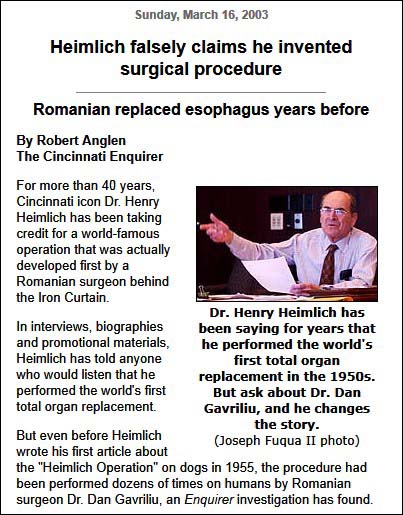
It looks like you've been punk'd, but it's unclear how badly. As you may know, for decades my father has provided all sorts of false information to reporters at the Enquirer and plenty of other media outlets. Former Enquirer Robert Anglen busted him on one such fabrication in this March 16, 2003 Sunday front-pager: http://www.enquirer.com/editions/2003/03/16/loc_heimlich16.html
...The New Yorker interview was only a decade ago and although my father's getting up there in years, knowing his keen memory, I'd be surprised if he would have completely forgotten the incident.
Also, this morning you wrote me that my brother Phil Heimlich told you that this was the first time my father ever revived a choking victim using "the Heimlich." As you may know, as longtime vice president of the Heimlich Institute, my brother has a close professional as well as personal relationship with my father and has always lived in Cincinnati. Frankly, it doesn't make sense that Phil would be unaware of my father's choking rescue at the Banker's Club.
We will be updating our story before long. Thank you for sharing this information with us.
Mr. Grasha is out of the office for several days. Please refrain from emailing him over the holiday weekend.
Sincerely,
Michael Kilian
Later that evening at the same link, the Enquirer disappeared the original story and substituted a significant rewrite co-bylined by Mr. Grasha and staff reporter Bowdeya Tweh that included much of the information provided in my corrections request. (Click here for a copy of the now-MIA original version.)
Monday might not have been the first time Dr. Henry Heimlich performed his namesake medical procedure on a live choking victim.
...Heimlich told The Enquirer Thursday his encounter with Patty Ris at the Deupree House senior living facility, where they both live, was the first time he ever performed it on a person needing immediate aid. However, several published reports in the early 2000s from news outlets ranging from the BBC to the Chicago Sun-Times show interviews with Heimlich describing himself using the maneuver. In one interview, he said he helped a man at the former private dining club, the Banker's Club, in Downtown Cincinnati in 2001.
...Cincinnati.com initially published a story late Thursday about the incident, quoting Heimlich as saying this was the first time he'd ever performed his own maneuver on someone. But then one of his sons, Peter Heimlich, reached out to media organizations pointing out the existence of articles roughly 15 years ago.
Not even my brother Phil -- who for decades has been my father's right-hand man and attack dog -- would back him up this time:
Another son, local attorney Phil Heimlich, said he doesn't recall those media reports.
"All I can say is none of us had a recollection of it," Phil Heimlich said. "If dad did it, I would’ve heard about it."
This video clip may be the reason why.
It comes from a five-minute video interview of Phil that was widely-distributed to the media last week by Episcopal Retirement Services, which owns and operates Deupree House (more about that below):
Then the Enquirer's coup de grâce:
...It isn't the first time Heimlich's statements have been challenged. In 2003, The Enquirer reported that Romanian surgeon Dr. Dan Gavriliu disputed statements from the Cincinnati doctor that he developed an operation that uses a section of the stomach to bypass the esophagus. The Romanian doctor claimed Heimlich took credit for a procedure he developed years earlier.
In other words, when the Enquirer realized that my father had punk'd them, the paper responded by reminding readers about this singular March 16, 2003 expose (based on research by my wife Karen and me, and my outreach to the Enquirer in 2002):
In order to promote the recent choking rescue story, Episcopal Retirement Services prepared this promotional package of videos and photographs and a downloadable copy of my father's 2014 memoir, Heimlich's Maneuvers:
My father included no mention of his alleged 2001 Banker's Club choking rescue.
In other words, my father punk'd the Enquirer, my brother Phil, and Episcopal Retirement Services.
My father may not be the master scammer he used to be -- the Banker's Club turned out to be an exploding cigar -- but that's not too shabby for a 96-year-old.
######
Big hat tip to McKinight's editor James M. Berklan for his lively column today, This lifesaving coincidence definitely makes you swallow deeply, which steered me to the ERS promo kit. Don't miss reading his skeptical review of the Deupree House event, today's National Heimlich Maneuver Day festivities, and my brother Phil's involvement.
My favorite line? A better-timed rescue P.T. Barnum couldn't have orchestrated.
Here's Phil's bemused, chin-rubbing take on the coincidence: