Monday, June 1, 2015

Just in time for "National Heimlich Maneuver Day," The Hollywood Reporter's expose about my father fleecing celebrities gets nominated for a journalism award

Today via NationalCalendarDay.com:


Meanwhile, via a press release just issued by The Hollywood Reporter:
The Hollywood Reporter has been honored with 48 nominations — more than any other news organization -- for its original reporting by the Los Angeles Press Club's 57th Southern California Journalism Awards.

...Seth Abramovitch, senior writer, earned a feature, magazine nomination (over 1,000 words) for How Dr. Heimlich Maneuvered Hollywood Into Backing His Dangerous AIDS "Cure."
(The awards) will be handed out at a gala ceremony on Sunday, June 28, at The Millennium Biltmore Hotel in downtown Los Angeles.
 
Seth Abramovitch (source)

Via Seth's August 14, 2014 THR article (based on documents my wife Karen and I obtained from the Henry J. Heimlich Archival Collection, donated by my father to a University of Cincinnati library):
At the height of the crisis, the inventor of the famous anti-choking technique claimed HIV could be cured by injecting patients with malaria. New documents reveal how stars like Jack Nicholson and Ron Howard gave thousands to his cause.

...As his fundraising machinery hummed along, Dr. Heimlich drew up a new version of his institute letterhead, which now boasted its star-studded "Hollywood Support Committee." Alongside the names of (Bruce) Davison, (Jon) Voight and (Amy) Irving were those of Ed Begley Jr., Ted Danson, Anjelica Huston, Muhammad Ali and Bette Midler, none of whom would comment for this story. Richard Dreyfuss, also listed as a committee member, tells THR that he never met Heimlich nor did he ever support his malariotherapy efforts. But Asner, whose name also appears as a backer, does recall Heimlich with fondness: "I respected him as a worthwhile scientist," says Asner.
Paul K. Bronston MD (source)
 ...Hopeful that an effective AIDS treatment was within reach, all the guests (at Joanne Carson's fundraising event) buzzed, except for one: Dr. Paul Bronston, an ER doctor and chair of a medical ethics board who had tagged along with his friend, actor Bruce Davison, an Oscar nominee for the 1989 AIDS drama Longtime Companion. Bronston says he went to Carson's house that night with the intention of meeting the legendary man behind the Heimlich maneuver, knowing only that the topic was vaguely AIDS-related. But as the guest of honor spoke and video cameras captured every word -- Heimlich had commissioned a documentary about himself, according to correspondence with director Lisa Pelikan in 1993 -- Bronston couldn't believe what he was hearing. (Pelikan declined to comment.)
"I just f--ing hit the ceiling," Bronston, 63, tells THR. "I went f--ing crazy. It was dangerous, it was total bullshit. His proposal was giving malaria-infected blood to people who had AIDS. It doesn't take a genius to know that you don't give an infectious disease to somebody who has a suppressed immune system."
Jeanie Pyun (source)

Big congratulations to Seth and to THR editor Jeanie Pyun, who, when I first contacted her, immediately grasped the importance of the information and then shepherded the story through publication. Keep up the great work and good luck at the awards gala!


Wednesday, May 27, 2015

Part II: Three journalism ethics experts weigh in on Kurt Eichenwald's failure to disclose his wife's relationship to an organization he skewered in a Newsweek story

Kurt Eichenwald (source)
Triggered by a suggestion from Newsweek's Editor-In-Chief, I obtained comments from three journalism ethics experts re: whether or not former NY Times reporter and best-selling author Kurt Eichenwald should have disclosed his wife's relationship to a recent story he wrote for Newsweek.

In Part I, I reported about a dust-up between Eichenwald, who lives in Dallas, and the Philadelphia-based American Board of Internal Medicine (ABIM), which, according to the organization's website, certifies "more than 200,000" physicians.

In a March 10 Newsweek item, Eichenwald raked ABIM over the coals, claiming the organization charged member physicians excessive fees to take re-certification tests, required diplomates to shell out big bucks to attend conferences as a re-certification requirement, and padded tests with irrelevant information, making them more difficult to pass.

The result, according to Eichenwald, has been a significant increase in the number of doctors who flunked the test and were left uncertified by ABIM, a big deal for doctors trying to make a living.

Apparently he landed a direct hit, because ABIM's chair fired back with a next-day media statement that claimed Eichenwald's article contained "numerous and serious misstatements, selective omissions, inaccurate information and erroneous reporting."

Here's the part that caught my eye.
Finally, the author failed to disclose that his wife is an internist.
What the statement didn't say was whether his wife, Theresa F. Eichenwald MD, had ever been certified by ABIM and, if so, when?

Per my previous item, when I tried to find out, no one would talk.

The only information I could find was that, according to ABIM's website, Dr. Eichenwald was first certified by ABIM in 1993, but is no longer a diplomate. And according to the Texas Medical Board, in 2003 she informed that agency she was an ABIM diplomate.

So when was she last certified by ABIM and why is she no longer an ABIM diplomate? Is she certified by another board?

When I e-mailed Eichenwald and politely asked for details -- the first time I've ever communicated with the guy -- he went ballistic, throwing baseless, dumb insults at me.

I then politely asked Newsweek Editor-In-Chief Jim Opoco if he'd ask Eichenwald and let me know the results.

He promptly replied:
We disagree with your concept of what constitutes a conflict in journalism. I urge you to read some of the voluminous handbooks that exist on journalistic ethics rules regarding the definitions of a conflict.
Ahem.

I never suggested there was a conflict. I was simply trying to obtain facts to evaluate whether or not there might be a disclosure issue.

If so, it wouldn't be the first time. As widely reported, Eichenwald got into hot water over a 2005 front-page New York Times story he wrote about child porn.

Kurt Eichenwald and Justin Berry (source)
Via Seizures Hurt Memory, Ex-'Times' Reporter Says by David Folkenflik, NPR, October 19, 2007:
Eichenwald's reporting stemmed from his efforts to aid Justin Berry, who was both a victim and perpetrator of a Web pornography ring, and who was in league with several older men. 

...(Revelations) have surfaced that have raised more profound questions about Eichenwald's own actions. Most notable was his failure to inform editors at the Times that he and his wife had made a series of payments worth at least $3,100 to Berry and his business partners.
Folkenflik also reported:
In a story airing Friday on NPR's All Things Considered, Eichenwald reveals a secret that he had carefully guarded for more than two decades: His epilepsy had triggered so many and such severe seizures that, according to his neurologist, he suffers from "significant memory disruptions."
That condition must be a serious challenge, so Eichenwald can surely be commended for continuing to produce deeply-reported, high-profile journalism. 
 
In any event, since I have no expertise in journalism ethics, I welcomed Impoco's advice and contacted three prominent expert authors for comment.

In order to avoid coloring their perceptions, I provided them with an accurate general description of the situation and left out all names and identifiers.

Gene Foreman (source)
First from Gene Foreman, retired newspaper editor, Penn State professor of journalism, and author of the textbook The Ethical Journalist: Making Responsible Decisions in the Pursuit of News, published in 2009. According to Prof. Foreman, a revised/updated edition is scheduled for publication on August 1:
Journalists should be willing, even eager, to disclose any relationship that might possibly reflect on their perceived impartiality. In the case you described, the writer should disclose his wife's status. I see that as a minimum.

Disclosures are ethically a positive step but not always sufficient. Disclosures are appropriate for cases in which a perceived conflict is unavoidable or insignificant. In the situation we're discussing, a reader who has been made aware of the writer's relationship might still doubt that the story has been impartially reported and written.

As a managing editor for 33 years, I preferred that such a story be done by a reporter who has no personal connection to any person or organization being covered. To be clear: I wanted staff members to bring us news tips that they picked up through personal connections. However, the tip would then be independently evaluated and, if a story is assigned, it would be independently reported.

Chris Frost (source)
Next up is Chris Frost, Professor of Journalism at Screen School and John Moores University, both in Liverpool, England, and the author of several books about journalism ethics:

Clearly the journalist has the right to write about this accreditation body and, provided the evidence used for the critique stands up, at least to the extent of requiring a response, also has a duty to write about it as it is clearly a matter about which the public has a right to be informed. We then move on to the more subtle point and the focus of your question. How much of a part did the journalist’s spouse play in motivating the story or providing information and evidence?
My view is that journalists should always be as transparent as possible about sources in order to maximise trust amongst readers with regard to the evidence and its sources. When the journalist writing a story is directly involved, being clear about that does not mean the story may not be true, but it is important to inform readers of that so that they may rely more on evidence from external sources rather than believing the journalist has entirely limited subjective involvement.

Things get more complicated when journalists use sources that require confidentiality. Often stories are gathered and published using evidence from sources who would face considerable detriment if their involvement was known. It is not unusual to offer such sources confidential protection. That is the journalist would use the information they provide but would keep that sources involvement secret. Usually this would involve simply using phrases such as “sources within the company…” or “sources with inside information…”. Confidential sources should always be kept to a minimum and journalists should give as much information about them as possible without compromising their safety in order to allow readers to reach their own judgement about their reliability.

That becomes even harder when the source is a close family member. Journalists, just like everyone else, have a duty to protect their families but when family members give them inside information that is very unlikely to become public knowledge without that insider view they may also feel they have a duty to publicise a story that only someone in a similar circumstance is likely to be able to access. They are then obliged to treat that source as a confidential source and might be much more limited in what they write about the source. Of course, without reading the story it is impossible to judge the extent of the spouse’s involvement in the story. I have for instance written stories myself in the past that were triggered by my wife’s knowledge from her profession or personal interests but I have not needed to mention her as all the research for the articles was gathered from other sources. Her involvement was simply in tipping me off the existence of the issue.

If it were to turn out that the article was driven by the fact that the spouse was not re-accredited and was driven by a desire for revenge, then yes, we would need to know the connection. However if sources from elsewhere are used and the evidence is strong, the spouse’s profession might be purely coincidental or at least incidental to the story.

Kelly McBride (source)

Finally, this from Kelly McBride, Vice President of Academic Programs at the Poynter Institute and co-editor, along with Tom Rosenstiel, of the book, The New Ethics of Journalism: Principles for the 21st Century
In general, conflicts of interest should always be disclosed so the audience can decide. On top of that, news organizations have an obligation to mitigate conflicts of interest, by adding layers of editing, finding alternate reporters or adding reporting bandwidth to the story.

Because I don't know the specifics here, I can't really say what this newsroom should have done. I also can't say whether or to what degree the conflict created an ethical issue with story, without knowing the details.

It could be a big deal, or a little deal. It's hard to say.
Since my previous inquiry was something of a blindfold test, I'll send this item to the three experts in the event that they wish to comment further.


An eagle eyed journalist alerted me to this goof in a previous version of my item: "The result, according to Eichenwald, has been a significant drop in the number of doctors who flunked the test." Should have been "a significant increase," of course. I regret the error, have fixed it, and am grateful for the eagle eye.

Tuesday, May 12, 2015

R.I.P. Gordon Thomas Pratt (July 17, 1945 - April 6, 2015)

Via Skin & Ink magazine, October 2007


My friend Gordy Pratt, an entrepreneur turned self-taught graphic artist, died last month at the VA Hospital in Milwaukee, the city where he was born and spent most of his life.

The photos above are from a three-page article and photo spread I helped arrange that was published in the October 2007 issue of Skin & Ink, a hip tattoo arts magazine.

Via the article by British journalist and documentarian Tim Coleman:
There can't be many stranger or sadder tattoos than those adorning the body of Gordon Pratt. The words and pictures depict the terrible saga of a Milwaukee father's grief, the loss of custody of his three daughters and a trail of systematic abuse. Today, only one of the daughters is alive. "Getting tattooed," he says, "was a way to make sure l'd never forget what my children went through - the living and tormenting hell with their mother."

...In 1968, Pratt married his wife, Carol. It was the worst decision he ever made. During their 13 years of marriage, they had three daughters, Carlotta, Christina and Ciprina. It was only after their divorce in 1981, when the courts awarded Carol custody of the children, that the abuse began. In his many pages of recollections and illustrations, Pratt catalogues the horrors that Carol and her new partner, David, meted out to Christina.

...As well as abusing her children, Pratt's former wife, now remarried as Carol Spizzirri, has lied about her background. According to Pratt, she lied about having a college education, being trained as a nurse and having a Bachelor of Science in nursing. He also states that she perpetrated a scam on the state of Illinois by setting up a not-for-profit organization called the Save a Life Foundation (SALF), whose stated aim was to teach first aid to the nation's children. According to Pratt and a local TV news station, which investigated SALF, President and CEO Spizzirri's credentials are completely bogus.

...Perhaps the saddest chapter of this truly terrible story ended when, in 1992, Christina's troubled life finally came to an end. Intoxicated and not wearing a seatbelt, she accidentally lost control of her car, rolled it over and was flung onto the road. She died, about an hour later, in the hospital. Not content with the suffering she had caused when Christina was alive, Pratt says, "Carol manipulated the circumstances of her daughter's death for financial gain. She falsely claimed," he asserts, "that Christina died on the highway and could have survived, if she had received emergency aid. She then used this bogus claim as a way of boosting funding for the Save a Life Foundation."
Click here for the compilation page on my website of dozens of print and broadcast media exposes about  SALF, Carol Spizzirri's now-defunct nonprofit that's reportedly the target of an ongoing investigation by the Illinois Attorney General.

Spizziri -- once the darling of prominent officials, Illinois media, and my father(!) -- is also a defendant in a wide-ranging federal civil rights lawsuit filed by former SALF employee Annabel Melongo.

By providing documents and information to reporters and criminal justice professionals about his ex-wife (reportedly a twice-convicted adult shoplifter who now lives in a trailer park in Southern California), Gordy's efforts significantly contributed to both cases and to the downfall of her bogus nonprofit. 

Gordy told me that after making two small fortunes -- the first in commercial real estate, the second in speculating in the silver market -- he became an artist as a means to tell the story of his experiences.

Pages from The Oh No! Book reproduced in the October 2007 Skin & Ink article

Besides designing the tattoos that adorned him from the waist up, he created a handful of dynamic and engaging self-published graphic arts books.  

His most intimate work is the 285-page Oh No! Book, which chronicled the issues discussed in the Skin & Ink article. (Click here to download a pdf copy -- patience, it's a big file.)


Gordy is survived by: his daughter Ciprina Spizzirri Nugent (an actress and former Director of Communication's at SALF) and her husband Brian K. Nugent (a special effects artist in the film industry) both of Los Angeles; his sister, Sandra Marie Powers, and her daughter, Dawn Marie Ridgewell, both of Oconomowoc, WI.

Per Gordy's March 1, 2011 "informational data sheet" below, along with his sister and niece, Gordy named his longtime friend, Joseph A. Santoro of Milwaukee, a former restaurant owner, as his successor representative and agent. (As a courtesy, I've redacted their addresses and phone numbers, but I can share that information with interested parties. Click here to download the page.)

I'd welcome hearing from anyone who knew Gordy, including any reminiscences for possible publication in a future blog item. Click here to e-mail me.


Thursday, April 30, 2015

Part I: Does Kurt Eichenwald have (another) disclosure issue? Newsweek's Editor-In-Chief says "no" and Eichenwald blasted me for asking questions, but....

source
Via Seizures Hurt Memory, Ex-'Times' Reporter Says by David Folkenflik, NPR, October 19, 2007:
Investigative reporter Kurt Eichenwald was a star for years at The New York Times, and he won new acclaim in December 2005 with his front-page article exposing a sordid new online front in child pornography.

Eichenwald's reporting stemmed from his efforts to aid Justin Berry, who was both a victim and perpetrator of a Web pornography ring, and who was in league with several older men.

The ensuing story about Berry's world was a far cry from the coverage of corporate fraud that won Eichenwald journalism prizes and landed him on best-seller lists. He helped Berry get legal representation and arranged medical care, counseling and housing with some of the youth's relatives in Texas. Some media critics questioned the degree of Eichenwald's involvement in the life of the subject of his big story.

Eichenwald left the Times last fall for another job. Over the past seven months, during the prosecutions of two men involved in Berry's ring on related child-pornography charges, revelations have surfaced that have raised more profound questions about Eichenwald's own actions. Most notable was his failure to inform editors at the Times that he and his wife had made a series of payments worth at least $3,100 to Berry and his business partners.

Eichenwald said the payments were part of the effort he and his wife, Theresa, made to extract Berry from the child-porn business — and that he simply forgot to tell editors.

...In a story airing Friday on NPR's All Things Considered, Eichenwald reveals a secret that he had carefully guarded for more than two decades: His epilepsy had triggered so many and such severe seizures that, according to his neurologist, he suffers from "significant memory disruptions."

source

Via The Ugly Civil War in American Medicine by Eichenwald, published last month by Newsweek on March 10:
Are physicians in the United States getting dumber? That is what one of the most powerful medical boards is suggesting, according to its critics.
...On one side is the American Board of Internal Medicine (ABIM), which certifies that doctors have met nationally recognized standards, and has been advocating for more testing of physicians. On the other side are tens of thousands of internists, cardiologists, kidney specialists and the like who say the ABIM has forced them to do busywork that serves no purpose other than to fatten the board’s bloated coffers.

...The value to a doctor of being certified can scarcely be overstated. Many organizations will not hire uncertified doctors. And, without that stamp of approval, even doctors who open their own practices rarely receive permission from hospital boards to treat their patients in hospitals.
...So physicians shelled out money to the ABIM to take the tests, and then ponied up more cash to attend conferences and other programs for continuing medical education.
...But then ABIM decided that rather than just having doctors take one certification test, maybe they should take two. Or three. Or more...This was not cheap -- doctors spend thousands of dollars not only for the tests, but for review sessions, for time away from their practices.
...Then, something strange happened, doctors say. The tests started including questions about problems that had nothing to do with how doctors did their jobs.
...The result? According to the ABIM’S figures, the percentage of doctors passing the recertification test started dropping steadily. In 2010, some 88 percent of internists taking the maintenance of certification exams passed; by 2014, that had fallen to 80 percent.
In a next-day response to Eichenwald's article, ABIM chair David H. Johnson MD issued a media statement that included:
(The) author failed to disclose that his wife is an internist.
Next, via the March 25 Medscape Medical News :
Eichenwald disagrees that he had a conflict to disclose. "The argument is akin to saying that I can't write about politics because I voted," he said, adding, "Shouldn't being married to an internist make me pro-ABIM?" He asked that his wife not be identified.

Of all the criticisms of his article, Eichenwald said, the one that got under his skin was the one involving his wife and making her part of the story.

"It was despicable," he said, "[and] a sign of people who had nothing to say in response to the substance of the article.

"I don't react to bullies well. When they're bullying my family, I hit back."
So was Dr. Johnson's allegation relevant or simply bullying?

It seemed to me that determining  whether Eichenwald had an obligation to disclose any information about his wife -- Theresa F. Eichenwald MD, who practices in Dallas -- depended on whether or not she had a professional relationship with ABIM and, if so, did it present a concern?  

When I tried to find out, I didn't get very far.

I couldn't get answers from ABIM and when I asked Eichenwald, he threw a fit. 

First, here's a screenshot from Dr. Eichenwald's license look-up via the website of the Texas Medical Board:


2003's a long time ago, so I asked Gaby Laredo at the Texas Medical Board for the most recent date Dr. Eichenwald informed the board that she was certified by ABIM. She replied:
We do not verify if any physician is or is not specialty board certified. However, she last reported to the Board that she was certified in 2003.
Is Dr. Eichenwald still an ABIM diplomate?

No, according to this screen shot I took yesterday from ABIM's website:


So what years was she certified by ABIM? Per her husband's article, "The value to a doctor of being certified can scarcely be overstated," so why isn't she currently certified by ABIM? Did she choose not to re-certify with ABIM? Is she now certified by another board?

In an attempt to answer those questions, I sent multiple e-mail inquiries to Dr. Johnson (who claimed Eichenwald had a conflict of interest) and to Lorie Slass, ABIM's Senior Vice President of Communication.

I never received the information, so I sent an e-mail to Kurt Eichenwald in which I explained that for my blog I was reporting an item about his response to Dr. Johnson's allegation.

In my e-mail, I shared the information from the websites of the Texas Medical Board and ABIM, and submitted these questions:

1) What years was your wife certified by ABIM?

2) Is she still certified by ABIM? If not, is she currently certified by any other board(s) and if so which one(s)?

Here's his unedited March 31 reply:
Anyone obtuse enough to believe that my wife being a doctor is a story is not worth talking to and is merely someone too lazy to do actual reporting on real issues.

But I'll make the easy for you: My brother is a doctor, and so was my father. My mother was a nurse. My best friend is a doctor. My sister-in-law is a nurse. I have a doctor. I also like her very much. So I guess medicine is off the table.

And in the event I ever write about the judicial system: A friend of mine who saved my life is a judge. Law's out too, I guess.

My son is a wildlife biologist who studies the effects of climate change on species - so, guess that's out too. 

And on and on and on...

My point is - you're making a fool out off yourself. Find a conflict, not just a correlation. Every doctor who is contacting me is talking about how outrageous it is that ABIM dragged my wife into this. Those that don't end up being people who make money off of this system. That speaks for the wisdom of your piece.
In a same-day reply, I politely re-submitted my questions and also asked him to provide me with the name and contact information for his editor at Newsweek.

Here's his same-day response, also unedited:
I am not participating in a story written by someone who believes that dragging the reporter's wife into it is ethical. If my wife were, say, on the board of a competing credentialing organization, that would be a conflict. But - unless you are saying that the ABIM is in conflict with doctors - it is irrelevant and obscene, particularly since you don't even know if she played any role in it. She did not: My wife never knows what I am writing nor does she make any contribution to anything I write - ever. This is in the event of litigation to be sure she doesn't get dragged into it. The totality of her connection to this is that she receives journals in the mail and I saw a story about the ongoing dispute in Medical News (I think that is the name of the newspaper-isn magazine.) I did not discuss that with her and began researching the story and was shocked what I saw in ABIM's 990s and then started calling people involved in this dispute. She made no contribution and had no knowledge this was coming until it hit the internet. By your light, I can't research something already being *widely* reported (NEJM, Medical News, JAMA, etc) because my wife is a doctor? That's ridiculous. And show me once when a mass media journalist started dragged his family into a story simply because there was a correlation, rather than a causal connection.

But I can already tell...the fact that there is no connection and no rational explanation why this is a conflict ain't stopping this story. The illogic here is so obvious, and the fact that you are just operating off a series of false assumptions - one of which leads to such an obvious question you have never asked me, the answer to which undermines the entire thesis of your piece - that I recognize there is nothing that will give you pause. If I ever decide to reveal that answer -- which I will only do if ABIM manages to trick enough fools into continuing to drag my wife into this -- I will be sure to mention you never asked so people can all have a good laugh.

By the way...have you even LOOKED at the 990s? Have u even tried to understand why what's in there is a story that can't be ignored?
Given Eichenwald's 2007 admission that he suffers from "significant memory disruptions," a skeptic might question his recollections, but I simply chose to send him two courtesy follow-ups.

James Impoco (source)

I didn't receive a reply, so I phoned Newsweek and was connected to Editor-In-Chief James Impoco, to whom I explained that I was reporting about this for my blog.

He cordially offered to take a look, so I e-mailed him the above information, my complete correspondence with Mr. Eichenwald, and this request:
Would you please ask Mr. Eichenwald these questions and let me know his responses?

1) What years was your wife certified by ABIM?
2) Is she still certified by ABIM? If not, is she currently certified by any other board(s) and if so which one(s)?
He promptly replied, but instead of responding to my question, he provided this on the record statement:
We disagree with your concept of what constitutes a conflict in journalism. I urge you to read some of the voluminous handbooks that exist on journalistic ethics rules regarding the definitions of a conflict.
Contrary to his assumption, in reporting this story I've never expressed an opinion about any potential conflict. Since I have no expertise in journalism ethics, my opinion has no standing. I've simply attempted to obtain related facts based on Dr. Johnson's allegation.

David H. Johnson MD (source)

By the way, since Dr. Johnson threw the first stone, doesn't it behoove him to explain specifically why he thinks Mr. Eichenwald should have disclosed the information about his wife?

I'd also be curious to know Dr. Johnson's explanation why ABIM fails to provide the public with any information about diplomates other than whether or not they're currently certified.

Perhaps Mr. Eichenwald or another reporter will ask him.

Finally, in the interests of accurately representing Newsweek's position, I sent Mr. Impoco this follow-up :
Based on your statement, my understanding is that, re: the article in question, even if Dr. Eichenwald is currently an ABIM diplomate, Newsweek does not consider that to be information which should be disclosed to readers. If my understanding is incorrect, please clarify.
His reply:
Hi Peter. You are correct. Jim
Based on his suggestion that I consult journalism handbooks, I contacted the authors of three journalism ethics textbooks and asked for their opinions.

I'll be reporting their responses in Part II.

Part II: Three journalism ethics experts weigh in on Kurt Eichenwald's failure to disclose his wife's relationship to an organization he skewered in a Newsweek story, May 27, 2015.


This item has been slightly revised.

Thursday, April 9, 2015

Two days after my investigation request, the National Library of Medicine has replaced its "unconscious Heimlich" treatment recommendation

As I reported yesterday, on April 6 I filed a request with the directors of the National Institutes of Health (NIH) and the National Library of Medicine (NLM) to investigate this treatment recommendation which has been posted on the NLM's website since at least June 22, 2000:


I asked for an investigation because the "unconscious Heimlich" is reportedly not recommended by the American Heart Association or the American Red Cross, I'm unaware of any research that supports the treatment recommendation, and when I've asked A.D.A.M. Inc. -- the health care information company that supplied the information -- to provide me with citations to research that supports their treatment recommendation, I can't get an answer.

Yesterday the page was updated -- here's proof:


Here's what the page looks like now:


Among other unanswered questions, it's unclear on what basis the "unconscious Heimlich" treatment was ever recommended by the NIH/NLM.

Unless the agencies can produce legitimate evidence in the form of published research, it appears that for over 15 years they've been recommending an experimental medical treatment.

Wednesday, April 8, 2015

Has the National Library of Medicine been recommending an experimental medical treatment for at least 15 years? I've requested an investigation

source

The National Library of Medicine (NLM), on the campus of the National Institutes of Health in Bethesda, Maryland, has been a center of information innovation since its founding in 1836. The world’s largest biomedical library, NLM maintains and makes available a vast print collection and produces electronic information resources on a wide range of topics that are searched billions of times each year by millions of people around the globe. (source)

For at least 15 years, the NLM has recommended performing the Heimlich maneuver on unconscious choking victims based on information provided health information provider A.D.A.M. Inc.

A.D.A.M. was among the first group of companies to receive URAC accreditation for health information, and has maintained its accreditation since that time. The URAC accreditation seal indicates that A.D.A.M.'s consumer health products are in compliance with 49 rigorous standards of quality and accountability, verified in an independent audit by URAC (www.urac.org). URAC performs this audit every 2 years.

A.D.A.M.'s goal is to present evidence-based health information. Therefore, content in A.D.A.M. products is created by identifying the best available evidence from national guidelines, government agencies, and peer-reviewed literature, and then asking our writers and reviewers to create content based both on the quality of the evidence and its applicability to everyday practice.
(source)

The use of the Heimlich maneuver to revive unconscious choking victims is reportedly not recommended by the American Heart Association or the American Red Cross, and I'm unaware of any research in which the treatment has been tested, so in recent months I've attempted to learn the basis for the NLM's recommendation.

In years 2000, 2005, and 2007 the information was reviewed and approved by this series of physicians who presumably were hired by A.D.A.M.


When I recently asked Dr. Perez to provide me with supporting information, he replied:
To my knowledge, there is no definitive evidence for or against performing abdominal thrusts (on an) unconscious patient.
So on what evidence did he -- and the other doctors -- approve the treatment recommendation?

Isla Ogilvie PhD (source)

After receiving Dr. Perez's reply, I received a January 16 e-mail from Isla Ogilvie PhD, A.D.A.M.'s Strategic Content Director, informing me the information was being reviewed.

Since then, in several e-mails, I've asked her this question:
Did A.D.A.M. research the literature on the subject of "the Heimlich" for unconscious choking victims? If so, would you please send me citations to any relevant articles or studies?  
I haven't received a reply so a couple days ago I sent an investigation request letter with supporting documents to the directors of NLM and NIH. (Click here to download a copy.)

Via my letter:
1) This is to respectfully request that your offices review the following information and provide me with a determination whether or not the treatment recommendation meets the standards of your agencies.

2) If the treatment recommendation does not meet those standards, this is to respectfully request that your offices investigate how the information came to be published on the NLM website; the basis for A.D.A.M.'s recommendation of the treatment for at least 15 years; all details regarding URAC's review of the information; and that I be provided with the results of those findings.
I'm also looking into how much the NIH pays A.D.A.M. and will report the results.


Wednesday, April 1, 2015

BREAKING: UK tabloids report another "dog rescues choking master" story -- and an April Fool's Day invitation to media pranksters (UPDATE: I've nominated the lifesaving lab for an award)


Last April I blogged UK stupid press tricks? Three separate "dogs rescue their masters from choking" stories in the past four months about articles in the Daily Mirror, the Carmarthen Journal, and the Daily Star.

According to today's Daily Mirror and Daily Mail -- see the video above and the following screen shots -- the four-legged lifesaving spree continues!

source: Daily Mirror


source: Daily Mail

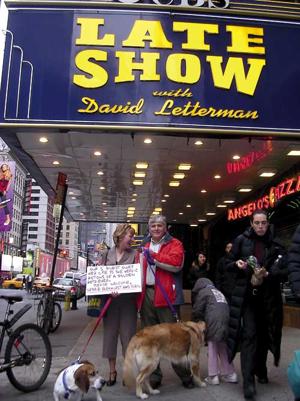
To my knowledge, the first recorded "dog rescues choking master" case was in 2007, when Debbie Parkhurst of Calvert, Maryland, claimed her pooch "Toby leapt up and down on her chest, dislodging the chunk of apple that had lodged in her throat."

The story was widely reported and even landed her and Toby an appearance on the Letterman show.

source

I have no reason to doubt the veracity of any of these stories. Plus they provide me with fun, bloggable material.

On the other hand, it's not so difficult to fake a choking rescue to gin up media attention.

For example, my father and country music star Luke Bryant apparently did.

Which leads me to this April Fool's Day challenge to merry pranksters out there.

Make up a story that your pet saved you from choking and get it reported by a mainstream news outlet.

Share the results with me and I'll likely blog it. (Click here for my contact info.)

So don't just stand there wagging your tail. Unleash your wits and see if any reporters roll over.

###

4/2/15 UPDATE:  As two eagle-eyed Sidebar readers (both of whom are journalists) wrote me, contrary to the headlines and text of the Mirror and Mail stories, Lexi the lab did not "Heimlich" his master.

The "Heimlich manoeuvre" (UK spelling) is an abdominal thrust -- a squeeze below the rib cage. Mr. Spencer's precocious pooch reportedly jumped on his back.

As it happens, Lexi's actions were in compliance with the first aid guidelines of St John Ambulance UK which, like the American Red Cross, recommends back blows as the first treatment response to a choking emergency.

One of the sharp-eyed readers also suggested that Lexi be presented with a lifesaving award, so I'm sending a nomination to St John Ambulance UK and will report the results.

Also on Lexi's behalf, yesterday I submitted corrections requests to the Mirror and the Mail. More about that later....